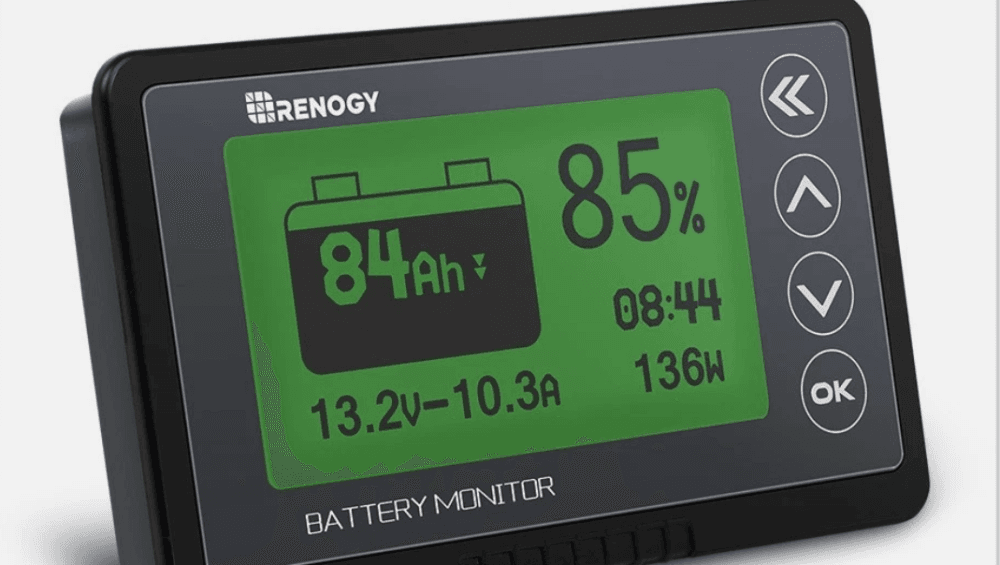
If you’ve recently upgraded your motorhome to a lithium battery system, you’ve probably come across the term “battery shunt.” While it may look like a small, simple component, a shunt plays a vital role in helping you monitor your battery’s performance and ensuring you always know how much power you have available.
In this blog, we’ll explain what a shunt is, how it works, why it’s essential for a motorhome lithium battery system and how it can help you get the most from your off-grid adventures.
What Is a Battery Shunt?
A battery shunt is a precision measuring device that monitors the flow of electrical current into and out of your battery. Installed on the negative battery cable, it measures every amp that enters or leaves the battery bank.
Rather than simply displaying the battery’s voltage, a shunt works with a battery monitor to calculate exactly how much energy has been used and how much remains. This gives you a far more accurate picture of your battery’s state of charge.
Think of it as a fuel gauge for your motorhome’s electrical system. Without it, you’re largely estimating how much battery capacity you have left.
Why Is a Shunt Important for a Motorhome Lithium Battery System?
Unlike traditional lead-acid batteries, lithium batteries maintain a relatively stable voltage throughout most of their discharge cycle. This means voltage alone is not a reliable way to estimate how much capacity is left.
For example, a lithium battery may still show around 13 volts whether it’s 80% full or 30% full. Without a shunt, it’s difficult to know your true battery level until it’s almost depleted.
A shunt solves this problem by accurately counting every amp-hour entering and leaving the battery, allowing your battery monitor to display:
- State of Charge (SoC)
- Battery voltage
- Current (amps) being used or charged
- Remaining battery capacity
- Time remaining at the current rate of use
- Historical charging and discharge data (depending on the monitor)
This information allows you to manage your power consumption confidently, whether you’re wild camping for a weekend or touring for several weeks.
How Does a Battery Shunt Work?
A battery shunt contains a very low-resistance metal element. As electrical current flows through it, the shunt measures a tiny voltage difference. The battery monitor then converts this measurement into the current flowing through the system.
Every time you switch on your lights, fridge, water pump or inverter, the current passes through the shunt. Likewise, when your solar panels, mains charger or DC-DC charger recharge the battery, that charging current also passes through the shunt.
By measuring both incoming and outgoing current, the monitor continually calculates exactly how much battery capacity remains.
Where Is a Shunt Installed?
A battery shunt is installed on the negative terminal of your motorhome’s leisure battery.
For the system to work correctly, every negative connection must pass through the shunt. This includes:
- Solar charging systems
- DC-DC chargers
- Mains battery chargers
- Inverters
- 12V appliances
- Fuse panels
The only cable connected directly to the battery’s negative terminal should be the short cable linking the battery to the battery side of the shunt.
If any equipment bypasses the shunt, the battery monitor will not measure that current, resulting in inaccurate readings.
What Happens Without a Shunt?
Many motorhomes rely solely on voltage readings from a control panel. While this may have been acceptable with lead-acid batteries, it isn’t suitable for lithium systems.
Without a shunt, you may experience:
- Inaccurate battery level readings
- Unexpected power loss
- Difficulty managing off-grid power usage
- Reduced confidence in your battery system
- Poor charging information
A shunt eliminates the guesswork, allowing you to make informed decisions about your energy use.
Smart Shunts vs Traditional Battery Monitors
Modern smart shunts have become increasingly popular because they connect directly to your smartphone via Bluetooth.
Using a companion app, you can view detailed battery information in real time without needing a separate display panel.
Many smart shunts also provide:
- Historical battery performance
- Charge cycle information
- Custom battery settings
- Alerts and notifications
- Data logging for troubleshooting
This makes them an excellent choice for modern motorhome lithium battery systems.
Is a Shunt Worth Installing?
In almost every lithium battery installation, the answer is yes.
Whether your battery bank is 100Ah or 600Ah, a shunt gives you accurate information that helps you:
- Protect your battery investment
- Avoid unexpected flat batteries
- Maximise off-grid camping time
- Monitor charging performance
- Diagnose electrical issues more easily
Considering the investment many motorhome owners make in lithium batteries, solar panels and inverters, adding a quality shunt is a relatively inexpensive upgrade that significantly improves the usability of the entire system.
Final Thoughts
A battery shunt may be one of the smallest components in your motorhome’s electrical system but it’s also one of the most important. By accurately measuring every amp flowing into and out of your lithium battery, it provides reliable, real-time information that voltage readings alone simply can’t deliver.
Whether you’re touring across the UK, exploring Europe or enjoying off-grid camping, a properly installed shunt gives you confidence that you always know exactly how much power you have available.
If you’re upgrading to a motorhome lithium battery system, installing a quality battery shunt alongside your battery monitor is one of the smartest investments you can make. It transforms battery monitoring from guesswork into precise, dependable information helping you enjoy worry-free adventures wherever the road takes you.
👉 Book your FREE lithium installation today: contact us
📞 01454 612 893 | 📧 service@bristolcaravans.com