If your motorhome or campervan has an underslung LPG gas tank, do you know how old it is?
It’s not something most owners think about. After all, if your gas appliances are working and everything seems fine, it’s easy to assume your LPG tank is in good condition.
But there’s something important you should know: underslung LPG tanks have a limited service life and need regular inspection to make sure they remain safe.
In many cases, the 10-year mark is an important point for inspection, testing or replacement, depending on the tank manufacturer’s guidance and the applicable requirements. Leaving it until something goes wrong is not a risk worth taking.
Here’s what you need to know.
How old is your underslung LPG tank?
The first question to ask is simple: do you know when your LPG tank was fitted?
Many underslung LPG tanks fitted to motorhomes and campervans have a 10-year inspection or recertification requirement. Depending on the tank and its condition, this may mean having it professionally tested and recertified or replacing it altogether.
The important thing is to know the date so that you can plan ahead rather than being caught out.
Start by checking your motorhome paperwork. The tank installation date or relevant service information may be recorded in your documents. If you can’t find it, ask a qualified LPG technician to inspect the underside of your vehicle.
The date or identification information is usually stamped into the tank itself, often on its underside.
It’s worth having this information recorded in your vehicle’s service paperwork so you know exactly where you stand.
Don’t wait until the 10-year point to start asking questions. Ideally, your servicing technician should identify the age of your tank well in advance and let you know when action will be needed.
Can you tell when an LPG tank is coming to the end of its life?
Unfortunately, not always.
Unlike a tyre or a battery, an LPG tank doesn’t necessarily give you an obvious warning that it’s approaching the end of its service life.
There will be no warning light on your dashboard, and your gas appliances may continue to work perfectly normally.
This is why checking the tank’s date and physical condition is so important. You cannot rely on how well your hob, fridge or heating system is working to tell you whether the tank itself is safe.
Why do underslung LPG tanks deteriorate?
Your LPG tank is mounted underneath your vehicle, where it is exposed to some pretty harsh conditions.
There are two main ways corrosion can develop.
1. Rust from the inside
Over time, moisture can accumulate inside a steel LPG tank. This can cause corrosion to develop from the inside out.
As the metal gradually deteriorates, it becomes thinner and weaker. Eventually, corrosion can lead to a perforation, creating a potential route for LPG to escape.
2. Rust from the outside
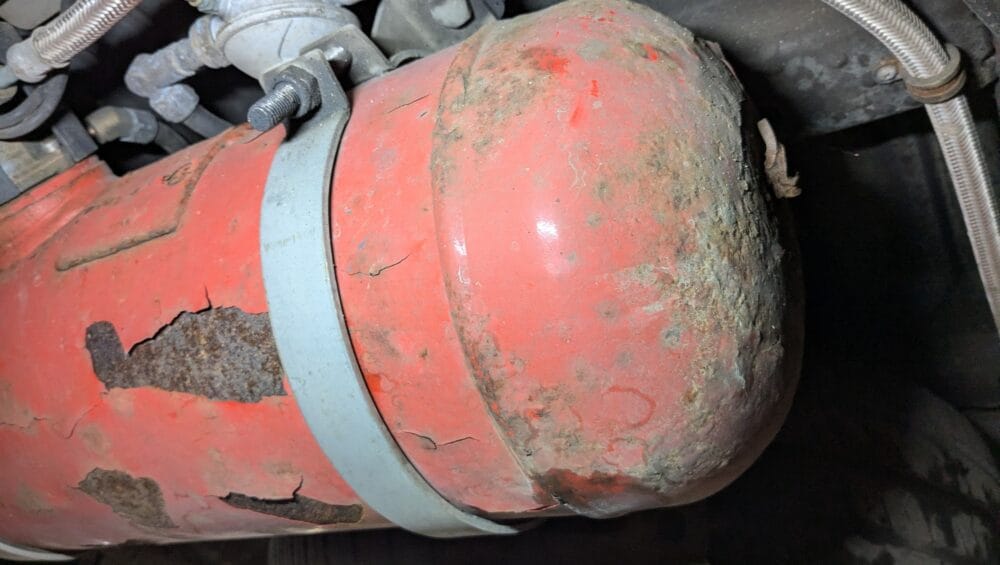
The underside of your motorhome is exposed to road salt, water, dirt, grit and small stones throughout the year.
Think about driving in winter when roads are regularly treated with salt. Add the occasional stone flicking up from the road and it’s easy to see how the protective coating on your tank can become damaged.
Once the paint or protective coating is chipped, rubbed or worn away, the exposed metal can begin to rust.
A small rust patch can gradually become larger and deeper, potentially weakening the tank over time.
This is why the protective coating on an underslung LPG tank is so important. Tanks should have appropriate underbody protection, and its condition should be checked regularly. If that protection is damaged, worn or missing, it needs to be assessed by a competent technician.
What should be checked during your habitation service?
If your motorhome has an underslung LPG tank, don’t assume it will automatically receive a detailed inspection just because you’re having a habitation service.
It’s worth specifically asking your servicing technician to check it.
At Bristol Caravans, we believe owners should be made aware of the condition and age of their tank, not simply given a quick visual glance.
A proper inspection should consider:
- The tank’s age: Check the stamped identification or date information and record it in your service paperwork.
- Corrosion and damage: Look for rust, dents, stone-chip damage and signs of deterioration, including areas that may be difficult to see.
- Protective coating: Check that the tank’s protective underbody coating is intact and hasn’t been rubbed away or damaged.
- Mountings and fixings: Check the security and condition of the tank’s brackets, straps and mounting points.
- The LPG regulator: Check its condition, age and correct operation. The regulator controls the pressure of gas supplied to your appliances.
- The isolation valve: Check that the tank’s on/off valve operates correctly. Depending on the installation, this may be a manual mechanical valve or an electrically operated 12-volt valve.
Any defects should be assessed and dealt with by a suitably qualified LPG technician.
What happens if you don’t replace a deteriorating LPG tank?
This is where the issue becomes particularly important.
If corrosion is allowed to progress, the metal of the tank can become increasingly thin until it eventually develops a hole.
That creates the potential for an LPG leak.
And this isn’t something you want to discover when you’re away on holiday.
Imagine settling down for the night in your motorhome, ready for a peaceful sleep, only to notice the smell of gas.
Or picture enjoying a barbecue with your grandchildren when you suddenly become aware of a gas leak nearby.
It’s an unsettling thought, but it’s exactly why preventative maintenance matters.
LPG is highly flammable. A leak can create a serious fire or explosion risk if escaping gas comes into contact with an ignition source.
You might be lucky enough to notice the distinctive smell added to LPG to help identify leaks. But you should never rely on being able to smell a problem before it becomes dangerous.
The aim of regular inspection is to identify deterioration and deal with it before the tank fails.
If you smell gas, don’t ignore it or attempt to investigate the leak yourself. Avoid naked flames and electrical switches, turn off the gas supply if it is safe to do so, move away from the vehicle and seek appropriate emergency assistance and professional advice.
A simple traffic-light approach to LPG tank inspections
We believe it should be easy for motorhome owners to understand the condition of their underslung LPG tank.
One useful way to communicate the findings is through a traffic-light system:
- GREEN – All OK: The tank is within its relevant service period, with no significant corrosion or damage identified.
- AMBER – Plan ahead: The tank is approaching its inspection or recertification date, or there are early signs of deterioration that need monitoring. You have time to plan for the work.
- RED – Action required: Significant corrosion, damage or another safety concern has been identified. The tank needs further assessment and may require replacement before the vehicle is used again.
The key is making sure you know what condition your tank is in, what needs doing and when.
Why choose Bristol Caravans?
At Bristol Caravans, we believe looking after your motorhome means looking beyond the obvious.
Your LPG system is an important part of your vehicle, and your underslung tank deserves the same attention as the rest of it.
When your motorhome comes to us for a habitation service, ask us to check your underslung LPG tank. We want to help you establish its age, assess its condition and make sure you know when inspection, recertification or replacement may be necessary.
We don’t want you to discover that your tank needs replacing when you’re preparing for your next trip.
A little forward planning can save you an unexpected expense, avoid disruption to your holiday plans and, most importantly, help protect you and your family.
Don’t leave it to chance. Know the age and condition of your underslung LPG tank.
If you have an underslung LPG tank and aren’t sure when it was last checked, get in touch with us and ask us about having it inspected.