Written by Oakleigh Wood
There is nothing quite like the excitement of arriving at your campsite, pitching your caravan, motorhome or campervan, and looking forward to a cold drink or a freshly prepared meal. But for many owners of modern caravans, particularly those built from 2020 onwards, that arrival ritual can come with an unpleasant surprise: a warm fridge, melted ice blocks, spoiled food or, heaven forbid, warm beer!
If you have noticed that your Thetford 3-way fridge works perfectly on gas and 230V mains electric hook-up, but completely fails to keep your food cold while you are towing, you are not alone. This isn’t necessarily a fault with your fridge, instead, it can be the result of a hidden compatibility issue between modern green car technology and traditional caravan design.
At the recent Bailey Owners Club rally in Bristol on Saturday, 12 September 2026, Thetford confirmed that they have carried out extensive research into cases of “poor operation when towing using 12V”. The company explained that when a separate power supply is introduced, the fridge operates correctly.
This is an important finding for caravan owners who have been struggling to understand why their fridge works perfectly when connected to gas or 230V mains electricity, yet fails to maintain the correct temperature when travelling.
The Technical Culprit: How “Smart” Cars Strangle Caravan Power
To understand why this happens, we need to look under the bonnet of your tow car.
Vehicles built to meet the Euro 6 emissions standards, introduced from around 2016 onwards, are commonly fitted with smart alternators. Unlike older vehicles, that pumped out a relatively constant and reliable stream of electricity, around 14.4V, whenever the engine was running, a smart alternator is controlled by the vehicle’s computer to save fuel and cut emissions.
When your car is cruising on the motorway, the vehicle’s computer may instruct the alternator to drop its output dramatically, sometimes down to 11.2V (Ford), or even under certain conditions, stop charging altogether.
For your car, this can help reduce engine load and save fuel.
For your caravan, however, it can be a disaster.
Your Thetford absorption fridge doesn’t use a compressor like the fridge in your home. Instead, when operating on 12V, it relies on an electric heating element to warm the chemicals (Ammonia), in the heat exchanger matrix. The element is extremely power-hungry, demaning a continuous, high current of around 10-15 amps, although some fridge models and brands can demand even more.
When the tow car’s smart alternator reduces its voltage, two things can happen:
1. The fridge heating element receives insufficient power
As the voltage supplied to the fridge drops, the heating element cannot draw the power it needs to operate effectively, rendering it useless as a cooler.
2. The caravan’s electrical system may shut the fridge supply down
Many modern caravans feature Voltage Sensitive Relays (VSRs) or electronic control units. When these systems detect that the vehicle’s voltage has fallen below a certain threshold, often around 13V, they assume you have turned the car engine off. To protect your car battery from draining, the caravan’s power management system shuts off power to the fridge completely. Essentially, your car goes into eco-mode, and your caravan fridge starves.
The Fixes: Three Ways to Keep Your 12V Fridge Operating whilst Driving
Thankfully, you don’t have to live with warm milk and melted food. There are three proven technical solutions to bypass this issue and restore a reliable 12V supply to your fridge while you tow.
Option A. Install a DC-to-DC Charger (The Ultimate Fix)
This is widely regarded as the gold-standard industry solution.
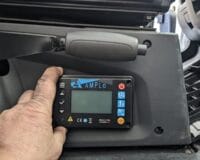
A Battery-to-Battery (B2B) also called a DC-to-DC (DC-DC) charger is installed directly into the caravan’s 12V supply line, to provide a stable, controlled voltage to the fridge, regardless of fluctuations in the tow vehicle’s charging system.
For a standard installation, the 12V supply can be taken from the live feed provided through the 13-pin towbar connector. However, it is important to remember that the 13-pin connector is generally limited to 15 amps. If you want a supply greater than 15 amp, seek professional help.
One potential solution for higher-power applications is to install a 20 amp DC-DC unit with an Anderson connection. The DC-DC charger uses an ignition or D+ signal to determine when the vehicle is running and switch the charger on. It then regulates the incoming supply and can provide a stable 14.4V draw from the engine battery. The DC-DC tricks the caravan’s power management system into thinking the engine is running at full capacity, ensuring the fridge gets a steady, powerful supply of electricity the entire journey.
Option B. Upgrade to an Ignition-Fed Relay Wiring System
Another option is to replace a conventional Voltage Sensitive Relay (VSR) arrangement with an ignition-fed relay system.
Many aftermarket towbar installers use VSR because they are quick and cheap to fit. However, a VSR relies on detecting the vehicle’s voltage. This can create problems with modern vehicles because the smart alternator may deliberately reduce the system voltage while driving.
Replacing this setup with an ignition-fed relay circuit fixes the issue at the source. By wiring the car-side socket to a relay that is physically triggered by the vehicle’s ignition switch (or engine D+ signal), you override the smart alternator’s decision-making. The high-amp 12V line remains wide open to the caravan the entire time the engine is running, regardless of voltage fluctuations.
The wiring is similar to a DC-DC install, but instead of using a sophisticated DC-DC charger to regulate the voltage, a relatively inexpensive relay is used to control the circuit.
Option C. ECU Remapping and Dedicated Towbar Coding
If you drive a modern vehicle from manufacturers such as Volkswagen Group, Ford or BMW, your car might already have the brains to solve the problem, it just needs to be told how.
Modern vehicles can use their electronic control systems to recognise when a trailer or caravan has been connected. However, this generally requires a manufacturer-specific dedicated towbar wiring loom, rather than a universal bypass system.
By fitting the correct dedicated towbar wiring and coding the vehicle’s Engine Control Unit (ECU), a qualified technician can configure the vehicle to recognise when a caravan or trailer is connected to the 13-pin socket. Once programmed, the car will automatically disable its aggressive eco-charging cycles whenever it detects a trailer plugged into the 13-pin socket, forcing the alternator to maintain the high current (amps) your fridge needs.
Simple Caravan Fridge Operational Checks
Before assuming there is a fault with your fridge, there are a few simple checks you can carry out.
1. Switch on the habitation 12V system
Your caravan’s habitation 12V system needs to be switched on. This supplies power to the fridge’s control panel and allows you to select the required operating mode.
2. Make sure the engine is running
The fridge’s 12V heating element is designed to operate while the tow vehicle’s engine is running. It will not normally operate from the caravan’s leisure battery when the engine is switched off.
3. Check the 13-pin or 12S plug connection
Make sure the 13-pin (or 12S) plug is pushed firmly and securely into the vehicle’s socket. A poor or loose connection can cause voltage drops or intermittent power, particularly when the combination is being subjected to road vibration.
4. Check the fuses and switches
Check the following:
- The fridge’s 12V power or fascia switch
- The relevant fuse on the caravan’s electrical control panel
- The tow vehicle’s dedicated fridge-supply fuse or relay fuse
Always replace a fuse with one of the correct rating. If a replacement fuse blows again, there may be an underlying electrical fault that requires investigation.
5. Pre-cool the fridge before travelling
For the best results, pre-cool the fridge before setting off. Ideally, run it on 230V mains electricity or LPG for 1–2 hours, or preferably overnight, before your journey.
6. Check the door and latch
Road vibration and bumps can cause a weak or worn door locks to pop open slightly, letting cold air escpae. Check that the seal is making proper contact all the way around.
7. Avoid overpacking
Don’t pack the fridge too tightly. Overpacking can restrict the circulation of cold air and create warm spots inside the fridge.
8. Check the exterior ventilation
The cooling system needs good airflow through the ventilation area behind the fridge. Remove leaves, dust, or insect nests, ensure good air circulation around the cooling fins on the back of the fridge.
9. Remove winter vent covers
If your fridge is fitted with winter ventilation covers, make sure they have been removed before travelling in warm weather. Winter covers are designed to restrict airflow in cold conditions. Leaving them fitted during warmer weather can reduce the fridge’s cooling performance.
Still got a problem?
We charge 1 hour for diagnostics, please email the following info to book an assessment:
To help us narrow down the best solution please let us know:
- The make, model, and year of your tow vehicle?
- The make, model, and year of your caravan, campervan, motorhome?
- Take a picture and email the Fridge model sticker (inside the fridge).
- If a caravan, do you know if your towbar was installed using a vehicle-specific dedicated wiring kit or a universal bypass?
- What brand of power control system (e.g., Sargent, BCA) is fitted inside your caravan?
The more information you can provide, the easier it is for us to identify whether the problem is with the fridge itself, the caravan’s electrical system, the towbar wiring, or the tow vehicle’s charging system.