Written by Alice Ramsay
If you’re choosing a leisure battery for a campervan, the decision usually comes down to two options: AGM or lithium. Both are sealed and maintenance-free, but they behave very differently once you’re away from hook-up. Here’s how they compare, why campervans are a special case, and how to decide which suits the way you travel.
The short answer
If you mostly stay on campsites with electric hook-up and take short breaks, a good AGM leisure battery will serve you well and costs far less. If you like to wild camp, tour for longer, or run your fridge, heater fan and devices every day, lithium is usually the better choice for a campervan. It gives you far more usable power, charges faster and weighs about a third as much as a lead-acid battery.
Why campervans are different
In a campervan, a few things matter more than they do in a larger motorhome:
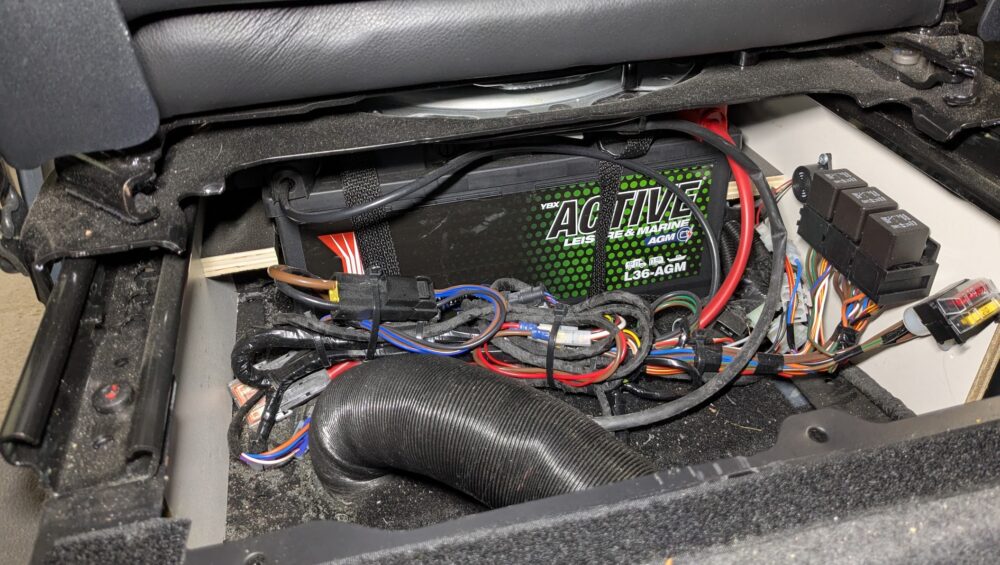
- Space. The battery usually lives under a seat or in a small locker, so the amount of usable power you can fit in that space really counts.
- Weight and payload. Every kilo matters on a van conversion, especially once you’ve loaded bikes, water and kit.
- Roof space. A smaller roof means less room for solar panels, so you want to make the most of every bit of charge you put back in.
- Smart alternators. Many newer vans have smart alternators, which don’t always charge a leisure battery properly while you drive. A DC-to-DC (battery-to-battery) charger fixes this. Read more in our guide: Can 12V Accessories Damage Motorhome Smart Alternators?
AGM leisure batteries
AGM (absorbent glass mat) batteries are sealed lead-acid batteries. They’re spill-proof, maintenance-free and widely available.
Pros
- Lower upfront cost
- Reliable and tolerant of irregular charging
- Performs well in cold weather
- Usually works with your existing charging setup
Cons
- Heavy
- Only about half the rated capacity is usable before you start shortening the battery’s life
- Slower to charge
- Typically 300–500 cycles
Best for: weekend and campsite trips where you’re plugged into hook-up most of the time.
Lithium leisure batteries
Lithium leisure batteries use lithium iron phosphate (LiFePO4) chemistry, with a built-in battery management system (BMS) that protects the cells.
Pros
- 80–90% of the rated capacity is usable
- Typically 2,000–5,000 cycles, so it lasts far longer
- About a third of the weight of a lead-acid battery
- Charges much faster
- Maintenance-free
Cons
- Higher upfront cost
- Your charger, solar controller and drive charging need to be lithium-compatible. See Can I Use My Charger & Solar Setup with A Lithium Battery?
Best for: off-grid stays, longer tours and anyone who uses a lot of power every day.
Lithium vs AGM at a glance
| AGM | Lithium (LiFePO4) | |
|---|---|---|
| Usable capacity | About 50% | 80–90% |
| Typical cycle life | 300–500 cycles | 2,000–5,000 cycles |
| Weight | Heavy | About a third of the weight of lead-acid |
| Charging speed | Moderate | Fast |
| Maintenance | None | None |
| Upfront cost | Lower | Higher |
| Charging setup | Usually works with what you have | May need a lithium-compatible charger and DC-to-DC charger |
Which is best for your campervan?
The headline figure on a battery can be misleading. A 100Ah AGM battery gives you roughly 50Ah of usable power, while a 100Ah lithium battery gives you roughly 80–90Ah. That’s close to double the usable power from the same rating, in a battery that weighs far less.
Choose AGM if:
- you mostly stay on sites with electric hook-up
- you take short breaks rather than long tours
- you want the lowest upfront cost
Choose lithium if:
- you like to wild camp or stay off-grid for more than a night
- you run a fridge, heater fan, lights and devices every day
- you want to save weight and space
- you plan to keep the van for years and want a battery that lasts
What to check before switching to lithium
Swapping a lead-acid battery for lithium isn’t always a straight swap. Before you upgrade, check:
- Your mains charger. It needs a lithium charging profile.
- Charging while you drive. A DC-to-DC charger protects the battery and works with smart alternators.
- Your solar controller. It needs a lithium setting.
- Winter touring. Lithium batteries shouldn’t be charged below freezing unless they have built-in low-temperature protection or heating.
- Monitoring. A shunt gives you an accurate picture of how much power you have left. See What Is a Shunt in a Motorhome Lithium Battery System?
For more detail, read Can I Replace My Leisure Battery with Lithium?
What it costs
We supply and fit leisure batteries from £290. For a complete lithium setup, our Off-Grid Essential kit includes a lithium battery fitted under the seat, with charging from a 200W solar panel, 50A drive charging and 35A hook-up charging. It starts from £4,380 fitted. Not sure which kit you need? Read Which Off-Grid Lithium Kit Is Right for You?
Every van is different, so we start with a free assessment and confirm the price before any work starts.
Why Bristol Caravans?
We’ve been looking after caravans, motorhomes and campervans since 2012. We’re an AWS Approved Workshop, an MCEA member and a Renogy Approved lithium installer, rated 4.8 on Google from over 260 reviews. Our workshop is in Almondsbury, Bristol, just off the M4/M5, and your overnight stay is free when you’re in for an upgrade. See our lithium battery installation service for more.
👉 Book your free assessment: call 01454-612-893 or email service@bristolcaravans.com