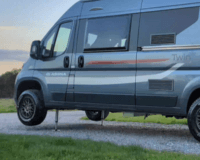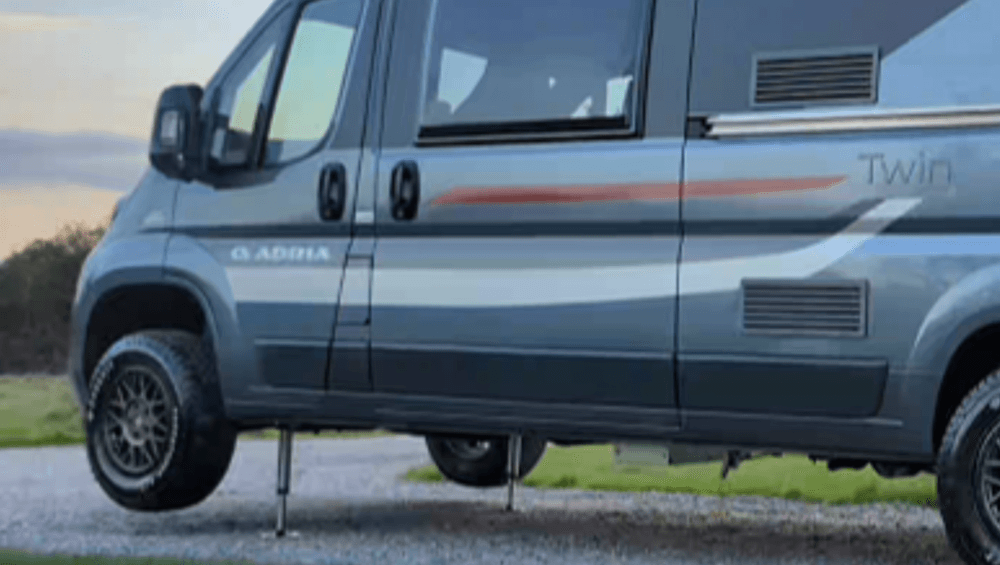
You’ve arrived.
The pitch looked fairly level when you pulled on, but now you’re parked up, it’s a different story.
The shower tray isn’t draining properly. Water is sitting in the sink. You can feel the slope when you walk around inside.
So out come the ramps.
A little further forward. Check it.
Back again. Try another ramp.
Eventually, you get there, but you’ve spent the first part of your stay getting the vehicle level.
Sound familiar?
For regular tourers, there’s another option: an automatic levelling system.
But choosing one isn’t simply a case of finding a system that fits your make and model. Chassis, weight, available space, lifting capability and how you actually use the vehicle all matter.
So let’s look at what’s really involved.
Why Does Levelling Matter?
If you’ve been touring for a while, you’ll already know the difference between being roughly level and actually level.
It affects more than just comfort.
Getting the vehicle properly level can help with drainage, reduce movement inside the vehicle and, depending on the appliances fitted, help them operate as intended.
Then there’s stability.
Once the levelling legs are down and supporting the vehicle, there’s much less movement when people are walking around, cooking or simply getting in and out.
On a sloping pitch, that can make a surprisingly big difference.
Manual Levelling vs Automatic Levelling
There’s nothing wrong with ramps and manual adjustment. For plenty of owners, they do the job perfectly well.
The difference with an automatic system is what happens every time you arrive on site.
Rather than judging the pitch, positioning ramps, driving onto them and checking the level again, the system does the adjustment for you.
Park up, deploy the system and let it level the vehicle.
It’s quicker, more repeatable and particularly useful if you tour regularly or often find yourself on uneven pitches.
Hydraulic or Electromechanical?
This is one of the more important decisions.
Hydraulic Levelling
Hydraulic systems use powered hydraulic rams mounted to the chassis. They’re generally the choice when you want greater lifting capability and a system that can deal with more significant changes in level.
Bristol Caravans fits systems including AMPLO, E&P, MA-VE and AL-KO, depending on the vehicle and application.
The advantage is the amount of control and lifting available.
That can be particularly useful for heavier motorhomes, uneven pitches and situations where the vehicle needs more than a small correction.
Electromechanical Levelling
Electromechanical systems use electric motors to operate the levelling legs rather than a hydraulic pump and rams.
They tend to be lighter and use less power, which can make them attractive for smaller motorhomes and campervans where payload and battery consumption need more consideration. Bristol currently offers TESA AutoLift systems in this category.
The trade-off is that they’re generally better suited to levelling within the vehicle’s existing suspension range rather than providing the same lifting capability as a hydraulic system.
Neither is automatically better. The vehicle tells you a lot about which approach makes sense.
Motorhome, Campervan or Caravan?
This is where a lot of the “universal” claims you see online fall apart.
A Ducato-based motorhome, a Sprinter campervan and an AL-KO caravan all have very different chassis arrangements and installation requirements.
For a motorhome or campervan, we’re looking at the chassis, wheelbase, axle weights, suspension, available mounting points and what’s already fitted underneath.
With a caravan, the chassis and running gear are completely different again, so the system needs to be matched accordingly.
The same levelling principle applies, but the engineering underneath the vehicle doesn’t.
Can You Retrofit a Levelling System?
Yes. You don’t need to have specified one when the vehicle was new.
Retrofitting is common, but compatibility needs to be checked properly before choosing a system.
The chassis and its configuration are obviously important, but so are the vehicle’s weight, available space underneath and where the system can safely be mounted.
This is particularly important with modified chassis, AL-KO setups, air suspension and older vehicles where there may already be additional equipment underneath.
That’s why we prefer to assess the actual vehicle rather than simply working from a make and model.
How Much Weight Does a Levelling System Add?
This is worth considering before you get carried away with the benefits.
A levelling system becomes part of the vehicle’s payload, so the weight needs to be accounted for alongside everything else you carry.
Hydraulic systems tend to be heavier because you’re carrying the rams, pump, hydraulic lines and associated hardware. Electromechanical systems can be lighter, although the exact figure depends on the system and vehicle. Bristol currently quotes motorhome systems in the region of 50–68kg, depending on specification.
It’s not usually a deal-breaker, but it should be part of the calculation.
If you’re already close to your payload limit, it’s better to know that before the system goes on rather than afterwards.
How Long Does It Take to Level?
Once installed, very little time at all.
Modern systems can level a motorhome in around a couple of minutes, with some systems capable of doing it in under two minutes depending on the vehicle and setup.
The bigger consideration is the installation itself.
A typical motorhome installation takes around two days, although this varies depending on the system, chassis and complexity of the vehicle. Electromechanical systems can often be fitted more quickly than hydraulic systems.
And that’s one area where we wouldn’t recommend rushing things.
There’s quite a lot going on underneath the vehicle, and getting the positioning, wiring and protection right matters far more than saving an hour on the installation.
What About Safety?
A levelling system is designed to be used when the vehicle is parked, so the safety controls are important.
Modern systems incorporate safeguards to prevent or warn against operation while driving. Depending on the system, this can include automatic retraction and alarms linked to the handbrake or vehicle controls.
But safety isn’t just about the electronics.
The physical installation matters too. The legs need to be mounted correctly, wiring and hydraulic lines need to be protected and everything needs to be positioned with the vehicle’s existing components in mind.
A good levelling system is only as good as the installation underneath it.
What Makes a Good Levelling Installation?
This is one of those things you might not think much about until you look underneath the vehicle.
Where do the hydraulic components go?
How are the cables routed?
What’s protecting the wiring from road spray?
Can the system still be accessed easily for maintenance?
Are the legs and brackets properly suited to the chassis?
These details matter.
At Bristol Caravans, we don’t simply bolt the system underneath and call it done. We look at the individual vehicle and work out how the system can be installed neatly, securely and with future maintenance in mind.
Where wiring needs to pass through a box section, for example, we take care to create a neat access point so the cables can be routed properly. Components and connections are also protected against the conditions they’ll be exposed to underneath the vehicle.
You might not notice those details when the system is working properly. That’s exactly how it should be.
Which Levelling System Is Right for You?
There isn’t one answer.
A smaller campervan used mainly on campsites may have completely different requirements to a large motorhome regularly spending time off-grid.
The things we’d look at include:
- The chassis and vehicle configuration
- Vehicle weight and available payload
- How much lifting capability you need
- Available space underneath
- Hydraulic or electromechanical operation
- Battery capacity and power consumption
- How and where you normally tour
- How much adjustment you actually need from the system
Once you know those things, the choice becomes much clearer.
Why Bristol Caravans?
For us, the important bit isn’t simply supplying a levelling system.
It’s making sure the system is right for the vehicle in the first place, then installing it properly.
We fit and support a range of systems across motorhomes, campervans and caravans, so we can look at the vehicle itself rather than trying to force every customer towards the same solution.
We’ll talk through what you’re trying to achieve, check the chassis and available options, and explain what each system will actually give you.
And when it comes to the installation, we pay attention to the details underneath the vehicle, from component positioning and cable routing to weather protection and future access.
The aim is a system that works with the vehicle, rather than simply being added to it.
Is Automatic Levelling Worth It?
If you only tour occasionally and you’re happy using ramps, you might not see the need.
But if you’re regularly arriving on uneven pitches, the appeal becomes pretty obvious.
No ramps to position. No driving backwards and forwards. No standing outside in the rain trying to decide whether you’ve got it level enough.
Park up, press the button and let the system do the work.
You get a more stable vehicle, less movement inside and a much easier setup every time you arrive.
For regular tourers, that convenience alone can make a big difference.
The Bottom Line
A levelling system isn’t just about making the vehicle look level.
The right system can give you better stability, a more controlled setup and a much easier time when the pitch isn’t doing you any favours.
But the important bit is getting the right system for the vehicle.
Chassis, weight, payload, lifting capability, available space and how you use the vehicle all need to be considered before deciding what to fit.
At Bristol Caravans, we can assess your motorhome, campervan or caravan, talk you through the options and explain what makes sense for your particular setup.
Want to find out which levelling system is right for your vehicle? Get in touch with Bristol Caravans to arrange a FREE assessment.