Off-grid motorhome travel offers the freedom to stay wherever you want without relying on campsite hook-ups. But achieving true energy independence requires more than simply fitting a lithium battery. The best setup depends on how long you stay off-grid, what appliances you use, how much you drive between stops, and where you travel.
Before recommending any battery system, it’s important to ask four key questions:
- Do you need to power 240V appliances off-grid? If so, which ones?
- How long do you spend off-grid?
- How much driving do you do between stops?
- Where do you travel?
The answers will determine the ideal battery capacity, inverter size, charging system and solar array.
Start With Your Power Requirements
Many motorhome owners assume they simply need more solar panels when they want to spend longer off-grid. In reality, the first step is understanding how much power you use each day.
Common 240V appliances can consume significant amounts of battery power:
- Induction hob: approximately 80Ah for 20 minutes of use
- Microwave: approximately 20Ah for 20 minutes
- Air fryer: approximately 30Ah for 20 minutes
- Coffee machine: approximately 4Ah per cup
- Kettle: approximately 6.5Ah for 5 minutes
- Toaster: approximately 5.5Ah for 5 minutes
Your everyday 12V equipment also contributes to daily consumption:
- Fridge: approximately 25Ah per day
- Heater: approximately 4Ah per hour
- Water pump and lighting: relatively small consumption
Understanding your daily energy usage is essential before choosing battery capacity.
Choosing the Right Battery Capacity
Battery capacity should be matched to the amount of time you intend to spend away from hook-up facilities.
Occasional Off-Grid Travel (2–3 Days)
For shorter off-grid trips where power requirements are modest, a 100Ah lithium battery may be sufficient if no inverter is required.
If you plan to use 240V appliances through an inverter, a 200Ah lithium battery paired with a 2000W inverter provides a more capable solution.
Regular Off-Grid Travel (3–7 Days)
For motorhome owners regularly spending several days off-grid, a 500Ah lithium battery becomes a more practical option.
A larger battery bank allows greater use of appliances such as microwaves, induction hobs and air fryers while maintaining sufficient reserve capacity.
A 2000W or 3000W inverter is typically recommended depending on appliance usage.
Extended Off-Grid Travel (7+ Days)
For serious off-grid touring and long-term wild camping, a 500Ah lithium battery combined with a 3000W inverter offers maximum flexibility.
This setup provides the capacity required for extended stays while supporting higher-demand appliances and larger solar installations.
Why Lithium Is Ideal for Off-Grid Travel
Lithium batteries provide several advantages over traditional lead-acid batteries.
More Usable Capacity
Lithium batteries offer around 90% usable capacity, compared with approximately 50% for lead-acid batteries. This means more of the stored energy can actually be used before recharging.
Longer Lifespan
Modern lithium batteries can achieve over 4,000 charge cycles while maintaining performance. By comparison, many lead-acid batteries offer around 500 cycles and gradually lose capacity over time.
Faster Charging
Lithium batteries can accept very high charging currents when the charging source is available. This allows much faster recovery from overnight usage.
Reduced Weight
A 200Ah lithium battery weighs approximately 23kg, while a 500Ah battery weighs around 50kg. An equivalent lead-acid battery bank would be significantly heavier.
Selecting the Correct Inverter
The inverter must be sized according to the appliances you intend to run.
Typical appliance power requirements include:
- Microwave: 800W–1000W
- Toaster: 800W–1500W
- Air fryer: 1200W–1800W
- Coffee machine: approximately 1500W
- Induction hob: 1800W–2500W
- Kettle: 1000W–3000W
If multiple appliances may operate at the same time, the inverter must be sized accordingly.
A 2000W inverter is suitable for many motorhome users, while a 3000W inverter offers greater flexibility for larger loads and extended off-grid use.
Charging While Driving
Battery capacity is only part of the equation. Replacing the energy you use is equally important.
For motorhome owners driving between destinations, DC-DC chargers provide reliable charging from the vehicle alternator.
Short Journeys (1–2 Hours)
- 30A–50A DC-DC charger for 200Ah systems
- 30A–60A DC-DC charger for larger systems
Longer Journeys (3–5 Hours)
- 60A+ DC-DC charger for larger battery banks
- Faster replenishment during travel
When sizing a DC-DC charger, factors such as alternator capacity, cable sizing and installation costs should be considered.
How Much Solar Do You Need?
Solar power significantly extends off-grid capability, particularly during summer months.
UK and Northern Europe
Recommended solar capacity:
- 120W–200W for smaller systems
- 200W–400W for larger battery banks
Southern Europe and Morocco
With increased sunshine hours, larger systems can benefit from:
- 200W or more for moderate setups
- 400W+ for high-capacity battery banks
There is no universal “perfect” solar setup. Available roof space often becomes the deciding factor.
Generally:
- Larger batteries benefit from more solar capacity.
- Less driving means greater reliance on solar.
- Longer stays off-grid require increased solar generation.
Monitoring Your System
Modern lithium systems offer excellent monitoring capabilities.
Bluetooth connectivity allows users to:
- Monitor battery status
- Track solar generation
- View charging activity
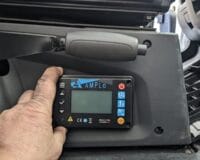
For more advanced installations, dedicated display screens and remote monitoring provide additional visibility into system performance.
Looking After Your Lithium Batteries
To maximise battery lifespan:
- Avoid leaving batteries permanently connected to mains power.
- Avoid storing batteries at 0% or 100% charge.
- Store batteries at approximately 50% charge for long periods.
- Isolate the system during storage.
- Top up the battery every few months.
Lithium batteries perform best when regularly used and cycled.
The Best Off-Grid Setup: A Practical Recommendation
Here are two examples of motorhome owners who enjoy wild camping and extended off-grid travel:
Standard User: Up to 4 days
- 200Ah lithium battery
- 2000W inverter
- 50A DC-DC charger
- 200W+ solar array
- Bluetooth monitoring system
Digital Nomad /Longer Term: 5 Days +
- 500Ah lithium battery
- 3000W inverter
- 60A DC-DC charger
- 400W+ solar array
- Bluetooth monitoring system
These are two combinations that provide sufficient capacity for everyday appliances, fast charging while travelling, and dependable solar replenishment when parked.
Ultimately, the best lithium battery setup is the one designed around your travel habits, appliance usage and off-grid ambitions. By correctly balancing battery capacity, charging capability and solar input, you can enjoy reliable off-grid power wherever your adventures take you.
For more information take a look at these pages: Lithium battery page & Renogy lithium page
👉 Book your FREE installation today: contact us
📞 01454 612 893 | 📧 service@bristolcaravans.com