Written by Oakleigh Wood
If you own a campervan or motorhome, there’s a good chance it spends more time parked on the drive than it does on the road. Maybe you take it away for a few weekends, head off on a summer holiday and squeeze in the odd winter trip. If you’re only covering around 5,000 miles a year, it’s easy to assume that your engine isn’t working particularly hard and that servicing can wait a little longer.
But there’s one important job where that way of thinking can catch you out: cam belt replacement.
The trouble with a cam belt is that it doesn’t always give you any warning when it’s getting ready to fail. Your engine can sound fine, your campervan can drive perfectly normally, and you can head off on holiday without a care in the world. Then, if the belt breaks, you could suddenly be looking at a very expensive engine repair.
So, let’s talk about the different types of engines we see in campervans, when you should be thinking about changing your cam belt, and why it’s worth getting ahead of the game.
Fiat, Peugeot and Citroën:
A lot of the campervans and motorhomes we work on are based on Fiat, Peugeot and Citroën vehicles. These manufacturers share some engine designs and components, so their servicing requirements can be similar, although the exact schedule depends on your particular engine.
For the vehicles we commonly deal with, we generally recommend planning for a cam belt replacement every five years, where that interval applies. You’ll need to check the manufacturer’s guidance for your specific engine, as not every model follows the same schedule.
Now, you might be thinking, “But I’ve hardly driven it!”
And that’s exactly the point. Cam belts don’t just wear out through mileage. They’re made from materials that deteriorate with age, too. Even if your campervan spends most of the year tucked away in the garage, the belt is still getting older.
That’s why we wouldn’t rely on mileage alone when deciding whether it’s time for a replacement.
While we’re there, let’s change the water pump too
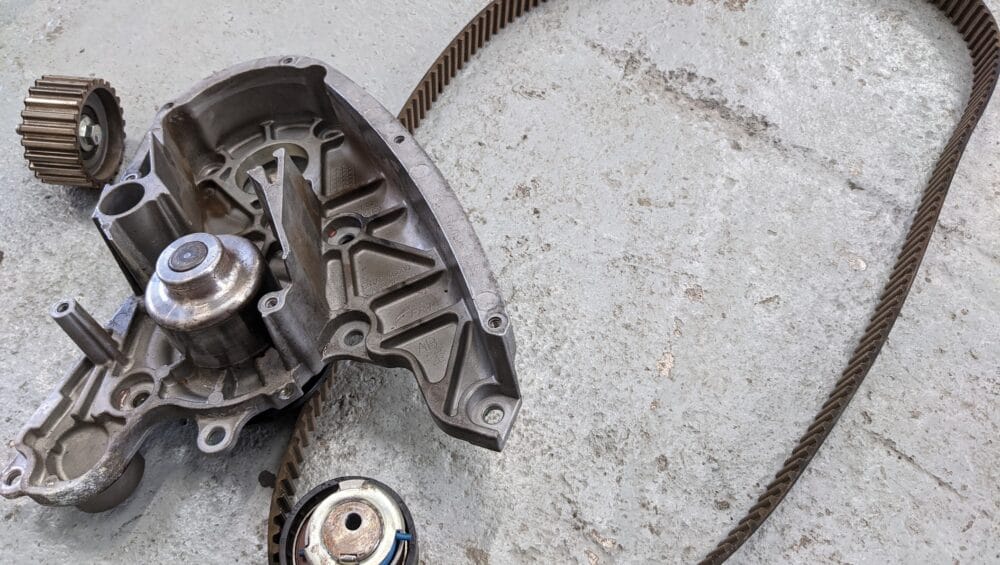
When it’s time to change your cam belt, we generally recommend replacing the water pump at the same time, where appropriate for your engine.
Why? Well, the water pump is often driven by the cam belt, and getting to it can involve much of the same labour as changing the belt itself. If the pump then needs replacing a year or two later, you could end up paying for a lot of that labour all over again.
It makes sense to deal with both jobs together.
A typical job may include:
- A new cam belt kit and associated components.
- A replacement water pump, where appropriate.
- Fresh antifreeze and coolant to replenish the system after the work.
It’s a little more to consider at the time, but it can save you the hassle and expense of having the same area of the engine dismantled again further down the line.
Ford 2.0-litre Diesel Engines: The Wet Belt
Ford is a slightly different story, and this is one worth paying attention to if you own a campervan with an applicable 2.0-litre diesel engine.
Some of these engines use what’s known as a wet belt. Unlike a conventional cam belt, which runs dry behind a protective cover, a wet belt operates inside the engine in contact with the engine oil.
That means the condition of the belt and the oil it runs in are particularly important.
Just to be clear, we’re talking about the applicable 2.0-litre Ford diesel engines fitted with a wet belt here, not every Ford engine. You’ll need to check exactly which engine you have before deciding on the right maintenance schedule.
Ford’s replacement guidance has changed over time and varies by engine and vehicle specification, so it’s important to confirm the correct interval for yours.
Our advice on Ford wet belts
At Bristol Caravans, we’d rather you were ahead of the problem than dealing with the consequences.
For the applicable engines we work with, our recommendation is to consider replacing the wet belt every three years as a preventative maintenance measure. This is our recommendation, rather than a universal Ford factory interval, so always check the guidance for your particular engine.
We’d also recommend changing the engine oil and oil filter every year, even if you’ve barely used the campervan.
And there’s a good reason for that.
Always use oil that meets Ford’s approved specification for your engine. A wet belt is designed to operate in contact with the engine oil, so using the wrong oil can contribute to deterioration.
When the oil is drained, it’s also worth checking for any signs of rubber debris. If bits of rubber are present, that could indicate the belt is breaking down and needs further investigation.
Why are we so cautious about wet belts?
Here’s where things can get expensive.
As a wet belt deteriorates, small particles of rubber can enter the engine oil. These particles can build up around the oil pick-up strainer and restrict the flow of oil around the engine.
Your engine needs a steady supply of oil to lubricate its moving parts. If that supply is restricted, critical components can be starved of lubrication. In the worst cases, the engine can suffer severe damage or even seize completely.
And here’s the worrying bit: you might not notice anything wrong when you’re driving.
The engine could sound normal, the campervan could feel exactly as it always has, and you could have no obvious indication that the belt is deteriorating. Meanwhile, the problem could already be developing inside the engine.
That’s why we don’t think waiting for a warning sign is a sensible approach. By the time something becomes noticeable, the damage may already be done.
Regular oil changes, the correct oil specification and a sensible belt replacement schedule are your best defence.
What About Mercedes-Benz?
If your campervan is based on a Mercedes-Benz, there’s a good chance your engine uses a timing chain rather than a conventional rubber cam belt.
That’s generally good news when it comes to routine, time-based belt replacement, because timing chains don’t usually have the same scheduled replacement requirements as rubber belts.
However, don’t assume you’re automatically in the clear. Chains can wear and develop faults, and the correct maintenance requirements depend on your engine.
The best thing to do is check which system your vehicle has and follow the manufacturer’s servicing guidance. If you have a timing chain, you won’t generally need to plan for a routine cam belt replacement, but you shouldn’t ignore any suspected problems.
The Important Thing to Remember: You Might Not Get a Warning
If there’s one thing we’d like you to take away from this article, it’s this: don’t wait until your campervan starts driving differently before thinking about your cam belt.
We’re used to noticing when things go wrong with our vehicles. A strange noise, a loss of power or a warning light gives us something to investigate.
Cam belts aren’t always so helpful.
A belt can deteriorate with age without causing any obvious change in how the engine feels. You might not hear anything unusual, notice any difference in performance or get a warning on the dashboard. Then, suddenly, the belt can break.
On many engines, a broken cam belt can cause internal components to collide, damaging valves and pistons and potentially resulting in a major engine repair or even a replacement engine.
With a wet belt, there’s the additional risk of rubber debris restricting the oil supply and causing serious damage before the belt itself actually breaks.
Neither is something you want to discover halfway through a trip away.
And remember, low mileage doesn’t necessarily mean low risk. Your campervan might only do a few thousand miles a year, but the belt is still ageing while it’s parked up.
That’s why keeping track of replacement dates is so important. A visual inspection can sometimes identify deterioration, but it can’t guarantee that a belt is safe to keep using. Following the correct replacement schedule is much more reliable than waiting for symptoms.
So, When Was Yours Last Changed?
If you’re sitting there thinking, “I’m not actually sure when my cam belt was last done,” don’t worry. It’s a good place to start, and it’s something you can get sorted.
Here’s what we’d suggest:
1. Find out which engine you have.
Check your handbook or service records. You’ll need to know whether your campervan has a conventional cam belt, a wet belt or a timing chain.
2. Have a look through your service history.
Can you find an invoice showing when the belt was last replaced? If you can’t find any evidence that it’s been done, speak to a qualified technician about the safest next step.
3. Check when it’s next due.
Make sure you’re using the replacement interval that applies to your exact engine. Don’t assume that all vehicles from the same manufacturer follow the same schedule.
4. Make a note of the date.
It’s easy to forget about a job that’s only needed every few years. Add the due date to your calendar or get it recorded in your service reminders.
5. Book it in before it becomes overdue.
It’s much easier to plan a maintenance visit around your schedule than to deal with an unexpected breakdown and a potentially hefty repair bill.
Let Bristol Caravans Help You Keep on Top of It
We know your campervan is something you look forward to using. The last thing you want is for a maintenance issue to spoil a trip you’ve been planning for months.
Whether you know exactly which engine you have and when your cam belt was last changed, or you’re not quite sure where to start, we’re here to help.
If you’ve got your service history to hand, you can check when your next replacement is due and get in touch with Bristol Caravans to arrange a booking. Not sure which belt your vehicle has or what interval applies? We can help you work that out, too.
We can also add your maintenance dates to our service reminders, so you’ll receive an email when your next cam belt replacement or service is approaching. It’s a handy way to keep track of those important jobs without having to remember every date yourself.
A little planning now means one less thing to worry about when it’s time to head off on your next adventure. Reach out to us today by email or telephone and we’ll be happy to help.
If you liked this article, please help us by clicking the Preferred Sources button, it means we will get noticed by Google – thanks in advance 🙂