If you’re thinking about upgrading to a lithium battery system, one of the first questions you should ask yourself is: how much power do I actually need?
It’s tempting to think that the answer is simply to buy the biggest battery you can afford. But that’s not necessarily the best approach.
The right system depends on how you use your motorhome, what appliances you want to run and, perhaps most importantly, how long you want to stay away from electric hook-up.
Some motorhome owners are perfectly happy spending a couple of nights off-grid with the basics. Others want to spend a week or more away from campsites, with enough electricity to run coffee machines, air fryers, laptops and all the other comforts of home.
These are very different requirements.
So, before you start looking at battery sizes, here’s a simple exercise that could tell you more about your off-grid power needs than any online calculator.
Try the orange hook-up lead test
This is a really simple tip, but it’s one of the best ways to understand how much off-grid power you actually need.
The next time you arrive on a campsite, get your orange electric hook-up lead out.
Unfurl it completely and lay it out between the electric hook-up post and your motorhome’s electrical inlet. Put one end next to the hook-up post and the other next to your motorhome, but don’t plug it in.
Now, enjoy your motorhome as you normally would.
Use your lights, watch television, make your drinks, charge your phones, run your fridge and use all the other things you would usually use during a trip.
The only difference is that you aren’t connected to the campsite’s electricity supply.
When you start to run out of battery, or your battery monitor tells you that you’ve reached the point where you would normally want to recharge, make a note of how long you’ve lasted.
That’s it!
You’ve just carried out a real-world test of your existing off-grid capability.
Rather than guessing how much electricity you use, you’ve experienced it for yourself.
Perhaps you’ve managed two nights. Maybe you’ve managed three, four or even longer.
Whatever the result, you’ve now got a much better idea of how long you can comfortably stay off-grid with your current setup.
And here’s something worth considering: that might actually be long enough for you.
If you normally only go away for weekends, and your existing battery comfortably lasts for two or three nights, you might not need to make any changes at all.
But if you regularly find yourself running short, or you’d love to stay away for longer, this exercise gives you a useful starting point for planning an upgrade.
What if you can’t carry out the test?
Not everyone will be able to carry out the orange lead test, particularly if you’re new to motorhoming or don’t have an opportunity to try it.
Fortunately, we have a useful real-world benchmark based on what our customers commonly tell us.
A typical motorhome with a 100Ah lead-acid leisure battery will often manage around two nights off-grid.
Why two nights?
It’s important to understand that lead-acid batteries shouldn’t regularly be discharged beyond approximately 50% of their capacity. Doing so can shorten their lifespan.
This means that, from a 100Ah battery, you should generally think of around 50Ah as comfortably usable.
If you’re getting two nights from that battery, the calculation looks like this:
- Total battery capacity: 100Ah.
- Approximate usable capacity: 50Ah.
- Time off-grid: 2 nights.
- Average daily consumption: 25Ah.
In other words, you’re using approximately 25Ah of electricity per night.
This is a useful average for a typical leisure vehicle user, although actual consumption will vary depending on the equipment fitted and how you use it.
It gives you a starting point for understanding your own electricity requirements and thinking about what a lithium upgrade could offer.
What do you want to run, and for how long?
Now you’ve got an idea of how much electricity you currently use, think about whether you’d like to power anything extra.
Start by listing the appliances you use in your motorhome. This might include:
- Lights, fridge and water pump.
- Heating fan and television.
- Phone, tablet and laptop chargers.
- Coffee machine, kettle or hairdryer.
- Air fryer or induction hob.
The first few are everyday essentials, but the others can make a much bigger difference to your electricity consumption.
It’s important to consider not just what you want to run, but how often and for how long.
For example, using a coffee machine for a few minutes each morning is very different from running an electric heater for several hours.
You’ll also need to consider whether your appliances run on 12V or 230V.
Most standard motorhome equipment runs on 12V, drawing power directly from your leisure battery. Household appliances generally require a 230V inverter to convert the battery’s electricity into mains power.
The power requirements of these appliances can vary considerably, so you’ll need to make sure your inverter is powerful enough to run them and your battery has enough capacity to supply the energy they need.
How long do you want to stay off-grid?
Once you know what you want to power, think about how long you want to go without connecting to electric hook-up.
Are you happy with a couple of nights away, or would you like to spend four, five or even seven nights off-grid?
As a simple example, if your daily consumption is around 25Ah:
- 2 nights would require approximately 50Ah.
- 4 nights would require approximately 100Ah.
- 6 nights would require approximately 150Ah.
These figures assume no additional charging during your stay and don’t include extra consumption from appliances you might want to add.
This is where solar panels and charging while driving become important. Both can put electricity back into your battery, helping you stay off-grid for longer without needing to rely entirely on your stored battery capacity.
Your requirements will also change depending on the time of year. Solar panels will generally generate considerably more electricity during the summer than during the winter.
The key is to think about your typical trips and plan around how you actually use your motorhome.
Don’t forget that lithium batteries give you more usable power
This is where upgrading to lithium becomes particularly interesting.
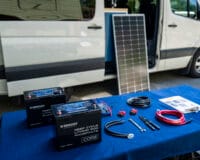
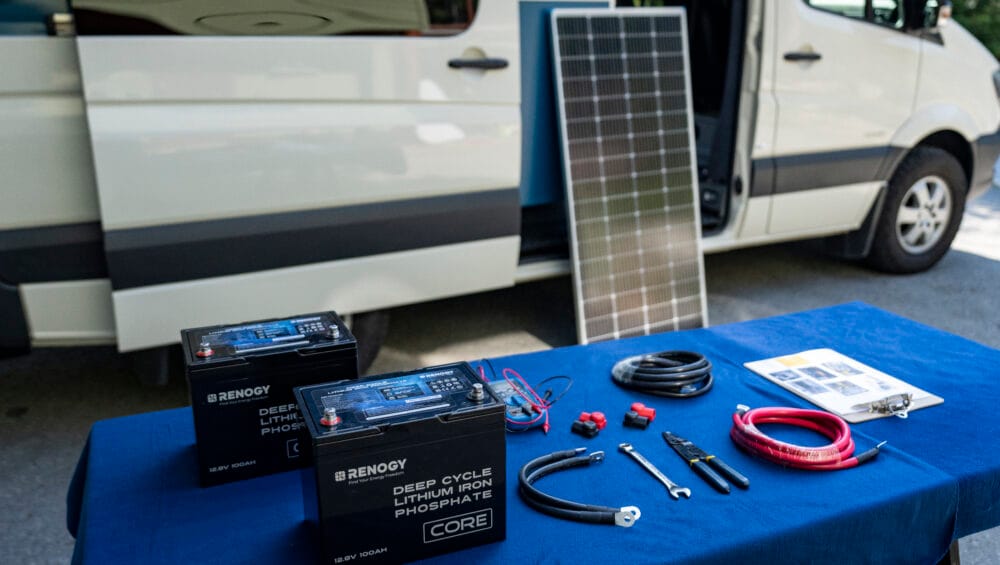
One of the biggest advantages of lithium leisure batteries is that they allow you to use a much greater proportion of their stored capacity compared with traditional lead-acid batteries.
Let’s go back to our earlier example.
A 100Ah lead-acid battery typically offers around 50Ah of comfortably usable capacity, as you should avoid regularly discharging it beyond approximately 50%.
A 100Ah lithium battery, on the other hand, can typically provide around 80–90Ah or more of usable capacity, depending on the manufacturer’s specifications.
That means a lithium battery of the same advertised size can give you considerably more usable electricity.
So, if your current 100Ah lead-acid battery gives you two nights off-grid, switching to a 100Ah lithium battery could potentially give you considerably longer between charges, assuming you use electricity in the same way.
It’s a good example of why it’s important to look beyond the advertised battery capacity and consider how much power you can actually use.
Don’t forget how you’ll recharge your battery
Battery capacity is only one part of the equation.
If you want to spend extended periods off-grid, you also need to consider where your replacement electricity is going to come from.
There are three main ways to recharge your leisure battery.
Solar panels
Solar panels can generate electricity throughout the day, helping to replenish the energy you’re using.
They’re particularly useful when you’re parked up for several days, as you don’t need to run your engine to generate electricity.
However, solar generation varies considerably depending on the weather, season, daylight hours, panel position and shading.
Charging while driving
A DC-to-DC charger allows your leisure battery to recharge from your vehicle’s electrical system while you’re driving.
This is particularly useful if you regularly move between locations, as you can replenish some of the energy you’ve used along the way.
Electric hook-up
Of course, you can also recharge your leisure battery when you have access to campsite electricity.
The best setup will depend on how you travel.
If you tend to stay in one place for several days, solar could be particularly important. If you regularly drive between destinations, charging while driving can make a useful contribution.
For longer off-grid trips, having a combination of charging methods can give you much greater flexibility.
So, how much lithium battery capacity do you need?
By now, you should have a much clearer idea of your requirements.
Before choosing a battery, ask yourself these questions:
- How long can I currently stay off-grid?
- How much electricity do I use each day?
- What additional appliances would I like to run?
- Do I want to use 230V household appliances?
- How many nights do I realistically want to spend away from hook-up?
- Will I have solar charging?
- Will I be driving regularly to recharge my battery?
Once you know the answers, you can start working out how much usable battery capacity you need.
For example, if you currently use around 25Ah per day and want to stay off-grid for four nights, you’ll need approximately 100Ah of usable energy.
If you want to use additional appliances, you’ll need to factor their consumption into that calculation.
You should also allow for charging efficiency, battery management system limits, inverter losses and a sensible reserve rather than planning to use every last amp-hour.
It’s worth remembering that your battery capacity and inverter requirements are two separate considerations. You might have plenty of stored energy but still need a larger inverter to operate a particular appliance.
Ready to get more from your motorhome?
The beauty of understanding your electricity requirements is that you can make a much more informed decision when it comes to upgrading.
You don’t necessarily need the biggest battery or the most powerful inverter.
You need a system that matches the way you use your motorhome and gives you the freedom to spend as long as you want away from electric hook-up.
At Bristol Caravans, we specialise in professionally installed lithium off-grid systems for motorhomes and leisure vehicles.
Whether you’re looking to extend your weekend trips or enjoy much longer stays off-grid, we can help you work out what’s needed to achieve it.
Get in touch with Bristol Caravans to discuss your off-grid requirements and find out which lithium system could work best for you.